CATEGORY

PWA

    iPhone PWA Not Working? Common Causes and Practical Fixes

    “Why is my PWA not working on iPhone?” If you’re asking this, you’re not alone. Since 2024, many developers and users have run into this exact issue. Here’s the truth: On iOS, PWAs often don’t work as expected due to Safari limitations. In this guide, we’ll break down the real causes—and show you fixes you can try immediately. 1. Safari Limitations (The Main Cause) On iPhone, all browsers use Safari’s engine (WebKit). This means PWA behavior is entirely controlled by Safari. After 2024, Apple restricted several PWA features: Unstable Service Worker behavior Incomplete manifest support Broken standalone (app-like) display So even if your setup is correct, PWA may still not behave properly. 2. Cache Issues (Old Version Still Showing) PWAs rely heavily on caching. Sometimes, the problem is simply that the old version is still being served. Common symptoms: Icon doesn’t update UI changes don’t appear Old content keeps showing This is not a bug— it’s how caching is designed to work. 3. Service Worker Not Updating Service Workers don’t update automatically in all cases. This can lead to: Old […]
      PWA vs WebClip: Which One Should You Use on iPhone in 2026?

      PWA vs WebClip: Which One Should You Use on iPhone in 2026? Both PWA (Progressive Web Apps) and WebClip allow you to place a website on your iPhone home screen. At first glance, they may seem similar—but they are fundamentally different technologies. And in 2026, the answer to “which one should you use?” is almost already decided. What is a PWA? A PWA is a technology that allows websites to behave like native apps. Fullscreen app-like display Offline support Advanced caching with Service Workers In short, it tries to turn the web into an app experience. What is a WebClip? WebClip is a built-in iPhone feature that simply creates a shortcut on your home screen. Opens in Safari No special configuration required Highly stable behavior It’s simple—but reliable. The Reality in 2026 (Key Differences) Feature PWA WebClip iPhone Support Unstable Stable App-like Display Mostly unavailable Not supported Offline Capability Limited None Manifest Support Unreliable Not required Overall Stability Low High As you can see, most advantages of PWA no longer apply on iPhone. Why Did This Happen? After 2024, Apple […]

        Is PWA Dead on iPhone? The Reality in 2026 and What Still Works

        Is PWA Dead on iPhone? The Reality in 2026 and What Still Works “Is PWA still usable on iPhone?” This question has become increasingly common since 2024. Here’s the short answer: PWA is not completely dead—but it no longer works as originally intended on iPhone. In this article, we’ll explain the current state of PWA on iOS and what you can actually do in 2026. 1. PWA Changed Significantly After 2024 In 2024, Apple made major changes to Safari. These changes were driven by regulatory requirements, but they had a huge impact on PWA behavior. Key changes include: Service Workers became unreliable Home screen apps changed their behavior Cache management became restricted As a result, the idea of “web apps behaving like native apps” became much harder to achieve on iPhone. 2. iPhone Now Uses WebClip Instead of Real PWA Today, when you use “Add to Home Screen” on iPhone, it works as a WebClip, not a full PWA. WebClip characteristics: Opens in Safari (not a standalone app) No true offline functionality Most manifest settings are ignored In simple terms, […]

          Why Your PWA Doesn’t Work on iPhone Safari and How to Fix It

          “Why doesn’t my PWA work on Safari or iPhone?” This question has become increasingly common since 2024. The short answer is: PWAs no longer function in their original form on Safari. In this article, we explain clearly and simply why PWAs don’t work on Safari, and what actually changed between 2024 and 2026. 1. Safari Never Fully Supported PWAs First, it’s important to understand that Safari has always had limited PWA support. Compared to browsers like Chrome: Service Worker behavior is restricted Push notifications work differently Installation behavior is inconsistent In other words, Safari was never a browser that fully embraced PWAs. 2. Major Changes After 2024 (EU Regulations Impact) In 2024, Apple made significant changes to WebKit (Safari’s engine) to comply with EU regulations. As a result, key PWA features became unstable or stopped working: Service Workers no longer behave reliably Home screen apps lose standalone app behavior Cache behavior becomes inconsistent This didn’t come with a clear “PWA is discontinued” announcement, but the practical effect was the same: PWA became unreliable on Safari. 3. iPhone Now Uses WebClip […]

            Understanding PWA Cache Strategies: Cache First, Network First, and Stale-While-Revalidate (Beginner-Friendly Guide)

            Understanding PWA Cache Strategies: Cache First, Network First, and Stale-While-Revalidate (Beginner-Friendly Guide) Among all PWA features, cache strategy is the part that confuses beginners the most. Service Workers make websites load faster, but they also introduce issues like: “The update didn’t apply” “The old data keeps showing” “The site won’t refresh” This article explains the three major caching strategies used in PWAs: Cache First, Network First, and Stale-While-Revalidate — in a way that even complete beginners can understand. What Is a Cache Strategy? A cache strategy simply defines: “Where should the browser get data from first — the network or the cache?” Because PWAs cache files locally, they can load extremely fast. But if the strategy is wrong, updates fail to appear and the user keeps seeing outdated content. ① Cache First Super fast — but rarely updates. How it works Check the cache first If cached, show it immediately If not cached, fetch from the network and save it Advantages Extremely fast after the first load Great for offline-friendly apps Disadvantages Updates often fail to appear Developers must carefully […]

              How PWA Affects SEO: The Real Advantages and Risks in 2026

              How PWA Affects SEO: The Real Advantages and Risks in 2026 Progressive Web Apps (PWAs) let websites behave more like native apps. But do they actually help SEO? In this guide, we break down the real impact PWAs have on search rankings—both the benefits and the hidden risks. The Conclusion First: PWAs Do NOT Increase SEO Rankings by Themselves Google has clearly stated: PWA status is not a ranking factor Google does not boost PWA-enabled sites PWA is considered a UX feature, not an SEO feature So installing a manifest.json or Service Worker will not magically increase your rankings. However—PWAs can influence SEO indirectly through speed and engagement. SEO “Benefits” of PWAs 1. Faster Load Speed (Indirect SEO Boost) PWAs can cache resources via a Service Worker, making repeat visits extremely fast. Since Google strongly values speed, this can positively influence SEO metrics. 2. Better User Engagement Lower bounce rate Longer session time Users open the site more often (like an app) These UX improvements are considered positive behavioral signals for Google. 3. Offline Support Although not a direct SEO […]

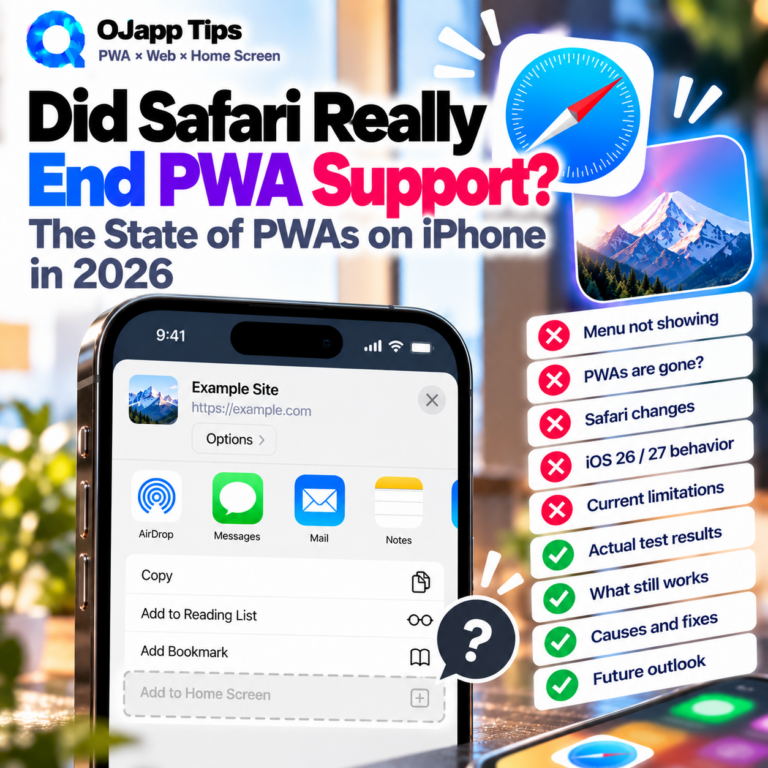
                Did Safari Really End PWA Support? The State of PWAs on iPhone in 2026

                “Did Apple kill PWAs on iPhone?” If you searched for information about Progressive Web Apps on iOS over the last few years, you may have seen claims that Safari was ending PWA support. There was a real reason for that confusion. In 2024, Apple announced plans to remove Home Screen web app functionality for users in the European Union as part of its response to the Digital Markets Act (DMA). But that plan was later reversed. And in 2026, PWAs on iPhone are not dead. In fact, recent versions of iOS have expanded how websites can behave when added to the Home Screen. So what actually happened between 2024 and 2026? Let’s separate the old headlines from how Home Screen web apps actually work on iPhone today. Are PWAs dead on iPhone in 2026? No. PWAs and Home Screen web apps are still supported on iPhone. Users can still add websites to the Home Screen and launch them as web apps. Web App Manifest settings are still supported, and developers can use them to define things such as: the app […]

                OJapp Tips  -  PWA・ホーム画面追加の実機検証ブログ

                OJapp Tips - Practical PWA & Home Screen UX Lab

                OJapp Tips is a technical blog documenting real-world PWA behavior, iPhone Safari quirks, home screen installation, manifest.json, Service Worker, Web App Manifest, WebClip, icon cache issues, and practical web development tips based on actual testing with iPhone, Android, and PC.

                The articles are based on hands-on experiments from PWA LAB and real development experience with OJapp, Petal, and OJ-Pass. Instead of only repeating official documentation, OJapp Tips focuses on the details developers actually get stuck on.